Company Registration in India —
Register Your Business the Right Way
Expert guidance for company registration in India — Private Limited, LLP, OPC, Partnership and Proprietorship. Get correct documents, right procedure and step-by-step support from start to finish.
What is Company Registration in India?
Company registration is the legal process of incorporating a business entity under Indian law, giving it a separate legal identity, limited liability protection and the right to enter contracts, own assets and sue or be sued in its own name. In India, company registration is governed primarily by the Companies Act 2013 and administered by the Ministry of Corporate Affairs (MCA) through the Registrar of Companies (ROC).
Every business owner — whether a first-time entrepreneur, a professional, a freelancer or an established trader — needs to choose the right business structure before starting operations. The type of company registration you choose determines your tax liability, compliance requirements, ability to raise funds and personal liability protection.
The most popular types of company registration in India are Private Limited Company, LLP (Limited Liability Partnership), One Person Company (OPC), Partnership Firm and Sole Proprietorship. Each has distinct advantages depending on your business size, goals and the number of founders involved.
Types of Company Registration in India
Choosing the right type of company registration is the most important first decision for any entrepreneur. Here is a detailed overview of the six main business structures available in India:
Private Limited Company
Best for startups, growing businesses and those seeking investment.
- Separate legal entity
- Limited liability protection
- 2 to 200 shareholders allowed
- Easy to raise funding
- Higher compliance
LLP Registration
Ideal for professionals, consultants and small business partners.
- Limited liability for partners
- Flexible management structure
- Minimum 2 partners required
- Lower compliance burden
- No dividend distribution tax
One Person Company
Perfect for solo entrepreneurs who want corporate benefits.
- Single founder allowed
- Separate legal entity
- Limited liability
- Nominee director required
- Easy to convert later
Partnership Firm
Simple structure for two or more people running a business together.
- Governed by Partnership Act
- Minimum 2 partners
- Simple registration
- Shared profits and liability
- Low compliance cost
Sole Proprietorship
Easiest structure for individual traders and small businesses.
- Single owner business
- Fastest to set up
- Lowest compliance
- No separate legal entity
- Unlimited personal liability
Section 8 Company (NGO)
For non-profit organisations, trusts and social enterprises.
- For charitable purposes
- Tax exemptions available
- No profit distribution
- Central government licence
- Credibility and trust
Company Registration Types — Side by Side Comparison
Use this comparison to decide which type of company registration is right for your business goals, team size and budget:
| Feature | Pvt Ltd | LLP | OPC | Proprietorship |
|---|---|---|---|---|
| Min. Members | 2 | 2 | 1 | 1 |
| Separate Legal Entity | ✔ | ✔ | ✔ | ✖ |
| Limited Liability | ✔ | ✔ | ✔ | ✖ |
| Can Raise Funding | ✔ | Limited | Limited | ✖ |
| Compliance Level | High | Medium | Medium | Low |
| Registration Time | 10–15 days | 10–15 days | 10–15 days | 3–5 days |
| Ideal For | Startups | Professionals | Solo founders | Small traders |
Documents Required for Company Registration
Having the correct documents ready before starting company registration saves time and avoids rejection. Requirements differ slightly depending on the business structure, but the following covers the standard documents needed in most cases:
Directors / Partners
- PAN card (mandatory for all directors)
- Aadhaar card or valid address proof
- Passport size photograph
- Digital Signature Certificate (DSC)
- Director Identification Number (DIN)
- Mobile number and email address
Registered Office
- Electricity bill or utility bill
- Rent agreement (if rented premises)
- NOC from property owner
- Bank statement (address proof)
- Property tax receipt (if owned)
- GST certificate (if available)
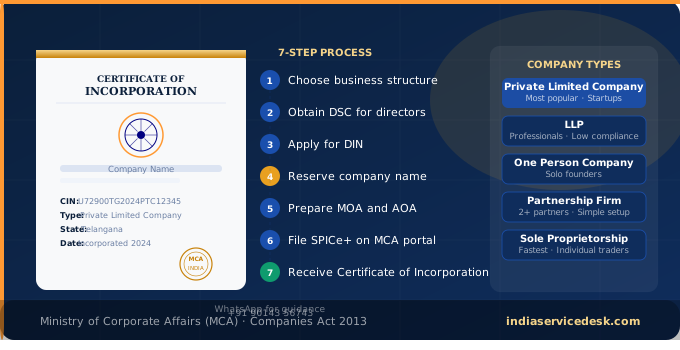
7-Step Company Registration Process in India
Here is the complete step-by-step company registration process in India. Following these steps in the correct order ensures a smooth and rejection-free registration experience:
Choose the Right Business Structure
Decide whether to go with a Private Limited Company, LLP, OPC, Partnership or Proprietorship based on your business goals, number of founders and compliance capacity. This is the most critical step as each structure has different legal and tax implications.
Obtain Digital Signature Certificate (DSC)
All proposed directors must obtain a Class 3 Digital Signature Certificate from a certified DSC provider. DSC is required to digitally sign all MCA forms during company registration. This usually takes 1 to 2 working days.
Apply for Director Identification Number (DIN)
Every proposed director must have a Director Identification Number (DIN) issued by the MCA. DIN can be applied through the SPICe+ form as part of the company registration process itself, or separately through the DIR-3 form.
Name Reservation via RUN or SPICe+
Reserve your company name using the RUN (Reserve Unique Name) service on the MCA portal. The proposed name must be unique, not identical or similar to existing companies, and must comply with the Companies Act naming guidelines. You can apply for up to 2 name options.
Prepare Memorandum and Articles of Association
Draft the Memorandum of Association (MOA) — which defines the company’s objectives — and the Articles of Association (AOA) — which governs internal rules and management. These are key constitutional documents of every Private Limited Company and OPC registration.
File SPICe+ Form on MCA Portal
Submit the integrated SPICe+ (Simplified Proforma for Incorporating Company Electronically Plus) form on the MCA portal along with all required documents, DSC of directors and the MOA/AOA. This single form handles company registration, DIN allotment, PAN, TAN and EPFO/ESIC registration simultaneously.
Receive Certificate of Incorporation
Once the ROC verifies and approves the application, the Certificate of Incorporation (COI) is issued digitally with the Company Identification Number (CIN). This certificate is the official proof of company registration. After this, apply for a bank account, GST registration and any other licences required for your business.
Benefits of Company Registration in India
Many small business owners delay company registration thinking it is unnecessary. However, running an unregistered business has serious legal and financial risks. Here are the key benefits of formally registering your company:
- Legal identity — your business can own property, open bank accounts and sign contracts
- Limited liability — your personal assets are protected from business debts
- Tax benefits — registered companies can claim business expenses and deductions
- Government tenders — most government contracts require registered entities
- Investor confidence — investors prefer registered companies over informal businesses
- Brand protection — registered company name is legally protected under MCA records
- Bank loans — MSME loans, mudra loans and business credit are easier to access
- MSME registration — company registration enables Udyam (MSME) registration benefits
What to Do After Company Registration
Company registration is just the first step. After receiving the Certificate of Incorporation, there are several important compliance steps to complete:
Why Choose Us for Company Registration Guidance
- End-to-end support — from structure selection to COI receipt
- Correct document checklist — no rejection due to missing papers
- All business types — Pvt Ltd, LLP, OPC, Partnership, Proprietorship
- MSME registered — experienced and trusted service provider
- Affordable fees — transparent pricing, no hidden charges
- WhatsApp support — convenient, walk in or contact us on WhatsApp
- Post-registration help — GST, MSME, bank account guidance
- All-India service — serving clients from every state